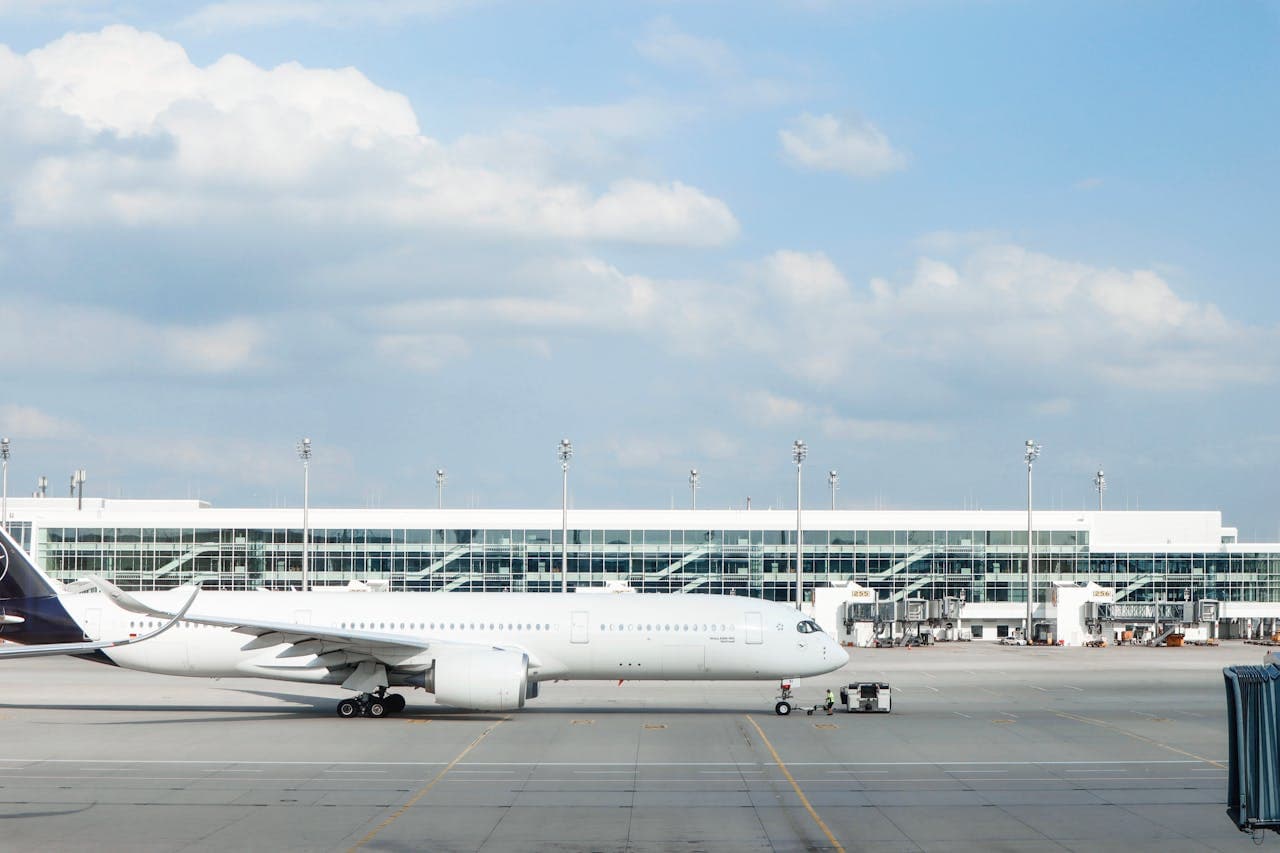
Flight delayed or cancelled at Molde Årø? With 240 rain days per year, Romsdal fjord crosswinds, and Atlantic storms, disruptions are frequent. Learn how to claim up to €600 compensation.
Key Takeaways
EU261 fully applies at Molde Airport — Norway's EEA membership covers all departing flights on every airline
Compensation ranges from €250 to €600 per passenger based on flight distance from Molde
With 240+ rain days annually and powerful Romsdal fjord crosswinds, Molde is one of Norway's wettest airports — but airlines must plan for these well-documented conditions
The short runway (1,400m) limits operations to smaller aircraft and makes the airport more sensitive to weather than jet airports with longer runways
You have 3 years under Norwegian foreldelsesloven to claim — but evidence from small regional airports degrades faster
Molde Airport Årø, IATA code MOL, is a regional airport serving the city of Molde and the surrounding Romsdal region on Norway's northwestern coast. Located on the small island of Årø in Romsdalsfjorden, connected to the mainland by a causeway, this compact airport handles approximately 300,000 passengers annually. Despite its modest size, Molde Årø serves as a vital transport link for one of Norway's most scenic regions — the gateway to the Atlantic Road, the Trollstigen mountain road, and the majestic Romsdal Alps.
Molde is known throughout Norway as "Rosenes By" — the City of Roses — for the thousands of rose bushes that flourish in its mild maritime climate. But that same Atlantic climate brings a less romantic reality: Molde receives over 1,500 millimetres of annual rainfall spread across more than 240 rain days per year, making it one of the wettest cities in Scandinavia. For aviation, this means that low cloud ceilings, heavy precipitation, and reduced visibility are not occasional events but persistent operating conditions that define the airport's character.
If your flight at Molde Airport was delayed by more than 3 hours, cancelled without proper notice, or you were denied boarding, you are entitled to up to €600 in compensation under EU Regulation 261/2004. This guide explains precisely how to exercise your rights at this challenging coastal Norwegian airport.
EU261 at Molde: Full Coverage Under Norwegian EEA Membership
The fundamental legal fact: EU261/2004 applies at Molde Airport with full force. Norway's membership in the European Economic Area means that EU aviation passenger rights regulation applies identically at Molde Årø as at Amsterdam Schiphol or Munich Airport. The size of the airport is irrelevant — your rights are determined by EU law, not by terminal square footage.
Your Flight
EU261 Applies?
Why
Molde → Any destination on any airline
Yes
All EEA airport departures fully covered
EU/EEA airport → Molde on any airline
Yes
Departure airport rules apply
Non-EU/EEA → Molde on EU/EEA airline
Yes
EU/EEA airlines covered globally
Non-EU/EEA → Molde on non-EU/EEA airline
No
Neither departure nor airline is EU/EEA
Important for tourists: If you flew to Molde to drive the famous Atlantic Road or hike Romsdalseggen and your flight home was disrupted, you have full EU261 protection regardless of nationality or airline.
Flight Disrupted at Molde Årø?
EU261 fully applies — every airline departing Molde is covered
No win, no fee — zero financial risk for your claim
We handle everything from airline negotiation to Luftfartstilsynet escalation
Most flights from Molde are domestic routes to Oslo (approximately 450 km), Bergen, and Trondheim, qualifying for €250 per passenger. But if your disruption caused you to miss a connection to an international destination, the full distance to your final destination determines the amount. A missed Oslo connection to London lifts the claim to €400; a missed connection to New York means €600.
Why Molde Airport Is One of Norway's Most Disruption-Prone
Relentless Atlantic Rainfall
Molde's coastal location directly in the path of Atlantic weather systems makes it one of Europe's wettest airports. With over 240 rain days annually and total precipitation exceeding 1,500 mm, rain is not an event at Molde — it is the baseline. Heavy precipitation reduces visibility, creates hydroplaning risks on the short runway, and generates low cloud ceilings that can drop below instrument approach minimums.
The rainfall is not evenly distributed — autumn and early winter (September to January) bring the heaviest precipitation, with frequent multi-day periods of continuous rain. During these periods, disruptions cluster together as the airport operates at the margins of weather minimums for days at a time.
Claim impact: This is perhaps the strongest argument for Molde compensation claims. Rain at Molde is overwhelmingly predictable and historically documented. Airlines cannot invoke "bad weather" as an extraordinary circumstance when the normal weather at their destination is heavy rain for two-thirds of the year. Only genuinely extreme precipitation events — record-breaking rainfall intensities far beyond the 240-day average — could potentially constitute extraordinary circumstances. We verify actual precipitation data against historical records for every claim.
Romsdalsfjorden Crosswinds
Molde Airport sits on the island of Årø in Romsdalsfjorden, one of western Norway's major fjord systems. The fjord channels wind from multiple directions, and the airport's runway alignment (07/25) means crosswinds are common. When Atlantic low-pressure systems drive wind up the fjord from the west, or katabatic drainage from the Romsdal Alps funnels cold air down tributary valleys, the resulting crosswind conditions can exceed the limits for the turboprop aircraft that serve Molde.
The surrounding mountainous terrain creates additional challenges: wind shear on approach, turbulence from mountain wave effects, and rotor currents that can make the final approach particularly rough. Pilots must be qualified for the specific Molde approach procedures.
Claim impact: Fjord wind patterns at Molde are seasonal and documented across decades of meteorological records. Airlines that schedule flights to Molde know they must assign crews trained for crosswind operations and use aircraft types with adequate crosswind certification. If the airline's aircraft had lower crosswind limits than competitors flying the same route, this is an operational choice, not an extraordinary circumstance. We compare the actual crosswind component against the aircraft type's certified limit.
Short Runway Limitations
Molde's runway is approximately 1,400 metres long — considerably shorter than the 2,500–3,600 metre runways at major Norwegian airports. This limits operations primarily to turboprop aircraft like the Bombardier Dash 8 series. The short runway also reduces margins during wet conditions, as braking distances increase on rain-slicked surfaces. Combined with Molde's extraordinary rainfall, this creates a narrower operational window compared to airports with longer runways.
Claim impact: The runway length is a permanent, known characteristic of the airport. Airlines choose to operate at Molde knowing the runway limitations and must select appropriate aircraft with adequate performance margins. If wet runway conditions within normal Molde parameters forced a cancellation because the aircraft type lacked sufficient stopping distance margin, this is an operational decision within the airline's control.
Seasonal Tourism Pressure
Molde experiences significant seasonal traffic variation. Summer months bring tourists for the Atlantic Road, Trollstigen, and the famous Molde International Jazz Festival. During these peaks, the small terminal becomes congested, ground handling is stretched, and the limited parking stands can create slot delays. Charter flights supplement regular services, adding pressure to an infrastructure designed for modest year-round traffic.
Claim impact: Summer tourism peaks at Molde follow the same calendar every year. Airlines must plan for increased demand and the resulting infrastructure pressure. Delays caused by predictable seasonal congestion are within the airline's operational planning responsibility. If the airline sold tickets for flights at a congested time knowing that ground handling capacity was limited, any resulting delay is not an extraordinary circumstance.
Flight Disrupted at Molde Årø?
EU261 fully applies — every airline departing Molde is covered
No win, no fee — zero financial risk for your claim
We handle everything from airline negotiation to Luftfartstilsynet escalation
Keep all evidence — Booking confirmation, boarding pass, and any airline communication. Photograph departure boards showing delays. If you missed a connection at Oslo due to a Molde delay, document both the Molde delay and the missed connecting flight.
Check eligibility — Our free online tool instantly verifies EU261 qualification. Enter your Molde flight number and disruption date.
File your claim — Complete the online form with all relevant details. Our legal team begins working immediately.
We handle the airline — We manage all correspondence with Widerøe, SAS, Norwegian, or any carrier. When airlines cite Molde rain as extraordinary weather, we present historical rainfall data proving that precipitation at Molde is entirely predictable and foreseeable.
Receive compensation — Payment to your bank account minus success fee. If unsuccessful, you pay nothing.
Your Care Rights at Molde Airport
While waiting for your delayed or rescheduled flight, the airline must provide:
Meals and drinks — Appropriate to waiting time, starting after 2 hours for domestic flights
Hotel accommodation — For overnight stranding, including transport
Free communications — Two phone calls, emails, or text messages
Re-routing or full refund — Your choice for cancellations
Molde Årø is a small airport with limited facilities — a modest terminal building with a small cafe and minimal retail. If stranded overnight, accommodation options in Molde town are adequate but limited in peak summer. The airline must arrange and pay regardless of availability challenges.
Connecting Flight Claims: The Oslo Connection
Most Molde passengers connect through Oslo Gardermoen. If a Molde delay caused you to miss your Oslo connection to an international destination, you can claim based on the total journey distance — not just the Molde–Oslo segment. A Molde–Oslo delay that caused a missed Oslo–London connection elevates your claim from €250 to €400. A missed Oslo–New York connection means €600.
The key requirement is that both flights must be on a single booking or connecting itinerary. If you booked the Molde–Oslo and Oslo–London flights separately, each segment is assessed independently.
Escalation Routes
If the airline refuses, escalate to Luftfartstilsynet (Norwegian Civil Aviation Authority) as the EU261 enforcement body. Transportklagenemnda (Transport Complaints Board) is an alternative that handles disputes efficiently. Norwegian courts have jurisdiction over all Molde departures and have consistently upheld EU261 passenger rights.
Time Limits
You have 3 years under Norwegian foreldelsesloven from the disruption date. This applies to all airlines operating from Molde. File promptly — Molde's small scale means operational records may be less comprehensively maintained than at major airports.
Why Avioza for Your Molde Claim
Molde claims present a unique dynamic: airlines exploit the perception that heavy rain is always extraordinary weather. In reality, rain at Molde is as predictable as sunshine in the Sahara. We leverage this to defeat the most common airline defence.
Meteorological expertise — We present historical Molde rainfall data that proves rain is the norm, not the exception
No win, no fee — Zero risk regardless of claim size
Connection claim specialists — We maximise your compensation when Molde delays ripple through Oslo connections
Full escalation path — Airline, Luftfartstilsynet, Transportklagenemnda, Norwegian courts
Fast processing — Most Molde claims resolved within 6–8 weeks
Frequently Asked Questions
Does EU261 apply at Molde Airport Årø?
Yes, completely. Norway is a member of the European Economic Area (EEA), which means EU Regulation 261/2004 applies at Molde Airport Årø with the same legal force as at any airport in the European Union. Every flight departing Molde is covered regardless of airline — whether it is SAS, Norwegian, Widerøe, or a charter operator. Flights arriving at Molde from other EU/EEA airports are also fully covered. The fact that Molde is a small regional airport does not diminish your rights in any way — EU261 makes no distinction based on airport size.
How much compensation can I claim for a disrupted Molde flight?
Compensation under EU261 depends on flight distance: €250 for flights under 1,500 km (Molde to Oslo, Bergen, or Trondheim), €400 for flights between 1,500 and 3,500 km (connecting through Oslo to London, Copenhagen, or Barcelona), and €600 for flights over 3,500 km (connecting to New York, Dubai, or Bangkok). Most Molde routes are domestic flights to Oslo qualifying for €250–€400 per passenger. These amounts are per person and independent of ticket price — even a heavily discounted regional fare entitles you to the full statutory amount.
My flight from Molde was cancelled due to heavy rain — can I claim?
Very likely yes. Molde is nicknamed the 'City of Roses' but it is equally famous for its extraordinary rainfall — over 240 rain days per year and annual precipitation exceeding 1,500 mm. Rain at Molde is not exceptional weather; it is the default condition. Airlines that operate scheduled flights from Molde Airport are expected to have crews trained for low-visibility approaches in heavy precipitation, aircraft equipped with appropriate systems, and schedules that account for weather-related delays. Only rainfall of genuinely extraordinary intensity — far exceeding historical records — could potentially qualify as an extraordinary circumstance.
Does the short runway at Molde affect my compensation rights?
No, your EU261 rights are identical regardless of runway length. However, Molde's runway (07/25) is approximately 1,400 metres — short by commercial standards. This limits the airport to turboprop aircraft and smaller jets, which can be more sensitive to crosswinds and wet runway conditions. If the airline selected an aircraft type that is known to have tighter crosswind limitations at Molde's runway length, this is an operational decision within their control, not an extraordinary circumstance. We examine whether the aircraft type was appropriate for known Molde conditions.
What airlines fly from Molde and are they all covered?
Molde Airport Årø is primarily served by Widerøe with Dash 8 turboprops on routes to Oslo, Bergen, Trondheim, and regional connections throughout Western Norway. SAS and Norwegian operate jet services to Oslo during peak periods. All airlines departing Molde are fully covered by EU261 through Norway's EEA membership. This includes any seasonal charter operators serving the Romsdal fjord tourism market. Your right to compensation is identical whether flying Widerøe's smallest Dash 8 or a larger jet.
How long do I have to file a claim for a Molde Airport flight?
Under Norwegian foreldelsesloven, you have 3 years from the date of your disrupted flight. This applies uniformly to all airlines operating from Molde. However, we strongly recommend filing promptly. Molde is a small regional airport operated by Avinor with limited staffing, and detailed operational records — crew logs, weather observations, maintenance data — may be archived or purged sooner than at major airports. The sooner you file, the more evidence is available to support your claim. Avioza begins evidence preservation immediately upon receiving your submission.
Ready to Claim Your Compensation?
It takes less than 3 minutes to check. No win, no fee.
Was your flight at Lentoasema (JYV) delayed or cancelled? Under EU Regulation 261/2004, you may claim up to €600. 1. Gather documents 2. Free eligibility check
Was your flight at Lentoasema (MHQ) delayed or cancelled? Under EU Regulation 261/2004, you may claim up to €600. 1. Gather documents 2. Free eligibility check
Karpathos Island National Airport (AOK) is one of Greece's most remote and operationally challenging aviation hubs, nestled in the Dodecanese archipelago between Rhodes and Kastellorizo. Serving the windswept island of Karpathos, this small airport handles seasonal international charters, domestic connections, and increasingly unpredictable flight disruptions due to severe weather and limited operational capacity.